Anthem Blue Cross and Blue Shield Behavioral Health Reimbursement Rates in Wisconsin (2026)
In Wisconsin, “Anthem Blue Cross and Blue Shield” is two companies sharing one trade name: Blue Cross Blue Shield of Wisconsin, which underwrites the PPO and indemnity business, and its subsidiary Compcare Health Services Insurance Corporation, which underwrites the HMO and point-of-service business and issues every individual exchange plan. The lineage is longer than the branding suggests: Wisconsin’s Blue was organized in 1939 as Associated Hospital Services, spent decades as Blue Cross and Blue Shield United of Wisconsin, took its current name in 2003, and became an Anthem company through the WellPoint-Anthem merger in 2004. Under the federal Transparency in Coverage rule, the negotiated rates behind those plans are published in machine readable files, replaced monthly. There is no single “Anthem Wisconsin rate” inside them: what a session allows depends on the plan, the clinician’s credential, and the contract behind each arrangement.
This page is Fuse’s aggregation of those files. Our software read Anthem’s September 2026 Wisconsin network file in full, 5 gigabytes of pricing once unpacked, kept every dollar-denominated fee schedule rate for the three CPT codes below, matched each listed NPI against the federal NPPES registry, kept individual behavioral health clinicians whose registered practice location is in Wisconsin, and computed statistics across distinct provider-rate pairs so a clinician appearing in many plans counts once per distinct rate. Anthem publishes every state’s files in one national index mixed with BlueCard mirrors of other Blues plans, so isolating genuine Wisconsin arrangements is the first methodology decision the rest of the analysis stands on.
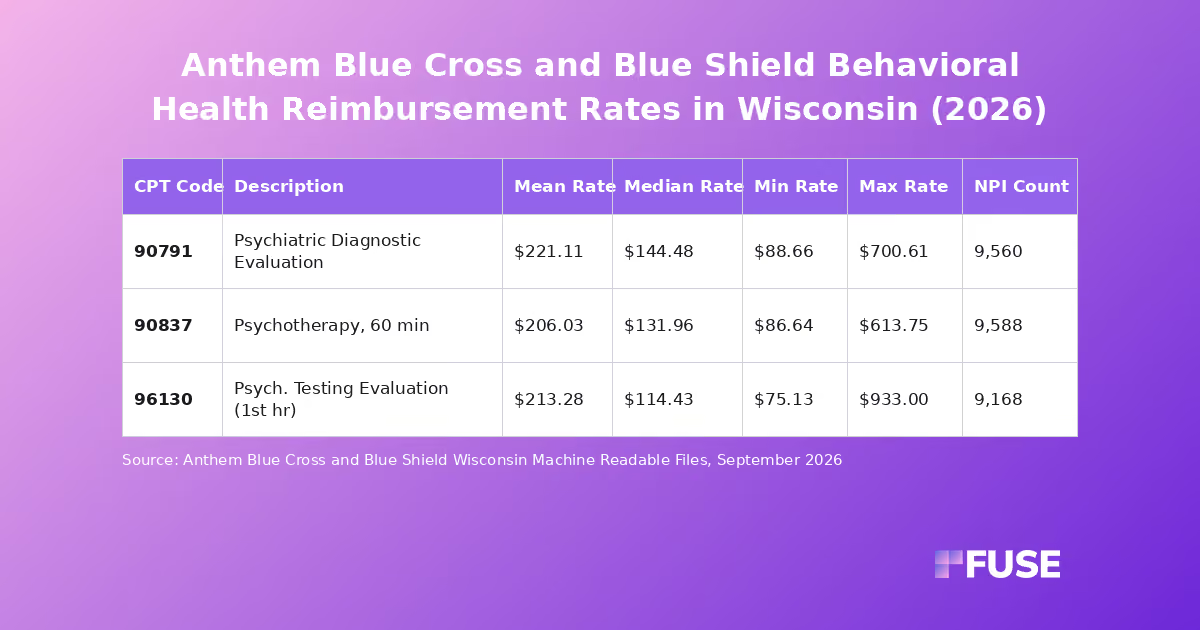
Anthem’s Negotiated Behavioral Health Rates in Wisconsin by CPT Code
The table below reflects September 2026 data for three commonly billed codes across Anthem’s Wisconsin network.
| CPT Code | Description | Mean Negotiated Rate | Median Negotiated Rate | Min | Max | Unique NPI Count |
|---|---|---|---|---|---|---|
| 90791 | Psychiatric Diagnostic Evaluation | $221.11 | $144.48 | $88.66 | $700.61 | 9,560 |
| 90837 | Psychotherapy, 60 minutes | $206.03 | $131.96 | $86.64 | $613.75 | 9,588 |
| 96130 | Psychological Testing Evaluation, 1st hour | $213.28 | $114.43 | $75.13 | $933.00 | 9,168 |
Rates extracted from Anthem’s September 2026 Wisconsin machine readable files.
Read the mean and median together before benchmarking against either. Wisconsin’s distribution is the most top-heavy Fuse has measured for a Blue plan: the mean for a 60-minute session ($206.03) sits more than half again above the median ($131.96), and the same shape holds for the diagnostic evaluation and testing codes, because a substantial block of Wisconsin arrangements pays far above the typical contract, reaching $613.75 at the top of the 90837 range. That is not a data quirk: the high and low rates run through the same settings and claim types, meaning the same insurer pays very different amounts for the same hour depending on the contract. The median is the honest “typical contract” number; the gap above it is the negotiating headroom this page exists to document.
The files are as-of snapshots that Anthem replaces monthly, so the figures drift as disclosures update; the extraction month above is the anchor.
Wisconsin Has No Telehealth Payment Law: The Contract Is the Whole Story
Georgia requires insurers to pay telehealth at the in-person rate. Ohio requires them to cover telehealth without dictating the rate. Wisconsin requires neither. A commercial telehealth mandate (a proposed insurance statute, section 632.871) has appeared in the Governor’s budget three times running, in 2021, 2023 and 2025, and the Legislature’s budget committee removed it each time. The 2025-27 budget signed in July 2025 does not contain it, so for state-regulated and self-funded plans alike, whether a virtual 90837 pays the office rate in Wisconsin is decided by contract language and nothing else.
The state’s own Medicaid program went the other way. A 2019 law (Wisconsin Statute 49.45(61)) requires ForwardHealth to reimburse covered services delivered through interactive telehealth, and ForwardHealth policy pays distant-site providers the same rate as face-to-face care, with audio-only phone visits allowed where they are functionally equivalent. For a Wisconsin practice with a heavy virtual caseload, the practical reading is blunt: the public program guarantees your telehealth rate and your Anthem contract may not. Read the telehealth clause before assuming the medians in the table travel to video sessions, and raise it explicitly at renewal, because no statute will raise it for you.
Wisconsin’s Own Parity Law, and the Exceptions Written Into It
Wisconsin has had its own mental health coverage law since long before the federal parity act. The rule in Statute 632.89 is simple: if an employer’s group health plan covers medical care, it must also cover mental health and substance use care, whether that care happens in a hospital, in an office, or in a day treatment program in between. The plan also cannot limit mental health care more tightly than it limits everything else it covers.
Two exceptions matter in practice. Employers with fewer than ten eligible employees are exempt, so patients who work for very small companies may not have this protection. And individual (non-employer) policies are not required to cover mental health at all, though when one does, the same no-tighter-limits rule applies. (Plans can also claim an exemption if covering this care pushes their costs past a small threshold, but that is rare.)
The current legislative session may add a further layer: a pending bill (2025 Senate Bill 342 and its Assembly companion) would require plans that cover mental health services to pay for at least 28 visits per policy year without prior authorization. It is pending, not law, but it signals where Wisconsin’s regulatory attention sits: on authorization friction rather than on rates.
Behavioral Health at Anthem Wisconsin Runs Through Carelon Review
Utilization management for behavioral health on Anthem’s Wisconsin commercial plans is performed by Carelon Behavioral Health, the Elevance Health subsidiary formerly known as Beacon Health Options; Anthem’s own Wisconsin provider communications carry the disclosure that Carelon provides utilization management services on behalf of the health plan. Under Carelon’s review framework, routine outpatient psychotherapy is generally not subject to blanket precertification and is reviewed when utilization patterns stand out, while higher levels of care such as intensive outpatient, partial hospitalization and residential treatment require authorization. Requirements are plan-specific, so confirm per member through the Availity authorization lookup rather than relying on the general pattern.
Network and credentialing questions can involve both organizations: some Wisconsin behavioral clinicians are assigned to Carelon for rostering and demographic updates while Anthem’s standard Availity and CAQH route covers the rest. When joining the network or adding a clinician, confirm with Anthem which track the file sits on before assuming either one; a credentialing application sitting in the wrong queue is the most common avoidable delay.
Wisconsin Medicaid: Administered Tiers Instead of Negotiation
Wisconsin Medicaid prices the same services on an entirely different logic than a commercial contract, which makes it useful context. ForwardHealth’s outpatient mental health fee schedule has used two rate tiers since 2018, set by the rendering clinician’s credential and signaled by claim modifiers: psychiatrists, prescribing psychiatric nurses and doctoral-level psychologists bill the higher tier, masters-level clinicians the lower one, an administered version of the license-level tiering that commercial contracts negotiate case by case. Those maximums rose 15 percent effective January 1, 2022 under the state budget, with some codes receiving an additional 5 percent federal pandemic-relief increase, and have not been raised since; a proposed further increase in the following budget did not survive the Legislature’s finance committee. The per-code maximums live in ForwardHealth’s interactive fee schedule on the state portal.
Two cautions when using that schedule as a floor reference: BadgerCare Plus HMOs negotiate their own rates with providers, which can differ from the fee-for-service maximums, and ForwardHealth itself tells providers not to set charges off the fee schedule. The comparison that matters for this page runs the other way: Anthem’s commercial numbers in the table are the product of negotiation, and where a specific contract lands relative to an administered public schedule is one signal of how much negotiating room exists.
What Wisconsin Practices Charge Self-Pay
Published cash schedules put goalposts around the negotiated figures. Counseling with TLC in Waunakee, outside Madison, publishes a fully CPT-coded schedule for its licensed therapists: $245 for a diagnostic intake billed as 90791 and $235 for a 60-minute session billed as 90837, with reduced tiers for pre-licensed clinicians. In Madison, HEART Counseling lists $250 for an initial assessment and $225 for a 55-minute session on its 2026 fee page (alongside an Anthem network contract, which is exactly the cash-versus-contract coexistence this page is about), and Madison Neuropsychological Services lists a $250 intake and $150 individual therapy sessions for private-pay clients. In Milwaukee, Shoreside Therapies, a private-pay-only practice, charges $200 for a 45-minute and $240 for a 60-minute individual session.
The spread across those four schedules, and the license-level tiering inside them, mirrors the structure of the negotiated data: there is no single Wisconsin price for a therapy hour, cash or contracted, only distributions shaped by credential and setting.
What This Means for Your Practice
Every number above depends on stated choices: Wisconsin-scoped network files, dollar-denominated fee schedule rates, individual behavioral health clinicians, Wisconsin practice locations. Different reasonable filters would move the averages, which is why the method is spelled out and the table reads as a market reference rather than anyone’s contract.
Demand context strengthens the reference point. Federal shortage data designates 174 mental health professional shortage areas in Wisconsin covering roughly 2.2 million residents, with well under half of estimated need met. A clinician deciding whether a below-median contract is worth renegotiating is not negotiating from surplus: the network needs coverage, and the payer’s own published distribution shows what it already pays other Wisconsin clinicians for the same codes. Pull what Anthem actually paid your practice per code from your remittances, set it against your contracted schedule and the medians here, and bring the gap, not a feeling, to the rate conversation.
Fuse does this work for practices: CPT-level verification of benefits before the visit, reimbursement checks against past claims, and analytics that flag the gap between contracted and paid before it compounds.
Verify Anthem Benefits Before the Visit
A statewide benchmark cannot say what one patient’s plan allows for one visit, least of all in a state where the telehealth rate is purely contractual and behavioral authorizations route through Carelon. Fuse verifies current eligibility and plan-specific benefits at the CPT code level before the appointment, combining past claims data with automated calls to payers, so the practice knows the expected copay, coinsurance and deductible before the patient sits down. See how CPT-level verification works for behavioral health practices.
Disclaimer: This article uses rate information from the Machine Readable Files that Anthem Blue Cross and Blue Shield publishes under the federal Transparency in Coverage rule. These files are posted to satisfy the regulation, not to be read: the data behind this analysis unpacks to 5 gigabytes of raw pricing, millions of negotiated rates that no spreadsheet can open. Fuse built software that reads it in full and verifies the figures above. This analysis focuses on a single payer and will not reflect rates from all available insurance options in Wisconsin. Fuse makes every effort to provide accurate and current information, but healthcare pricing can change frequently, and individual circumstances may affect actual costs. This information does not guarantee specific pricing. Practices should verify current rates directly with Anthem before relying on them for billing or negotiation decisions.
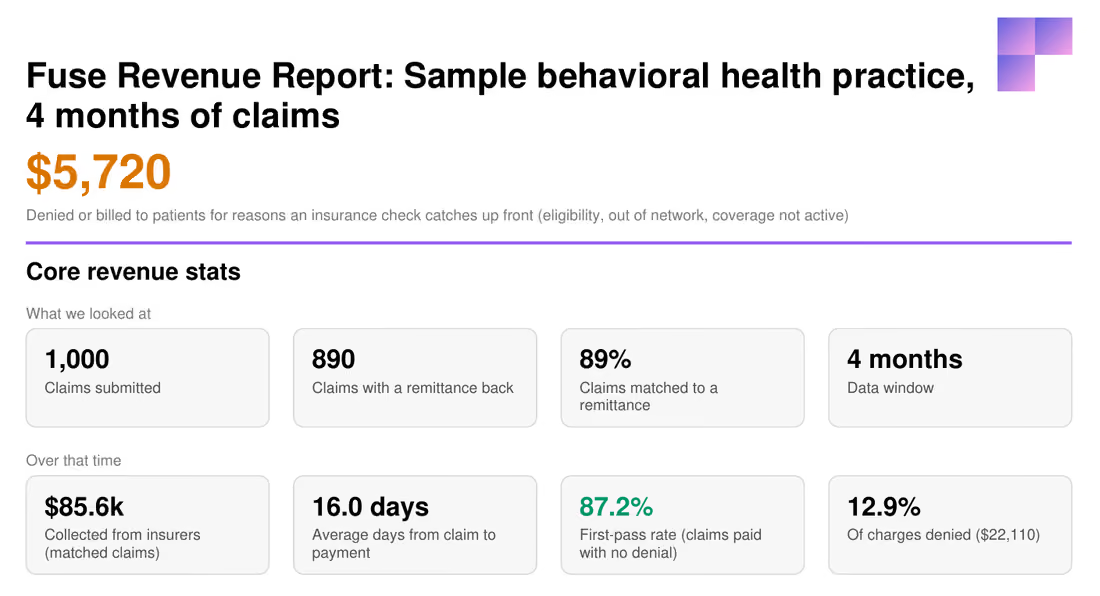
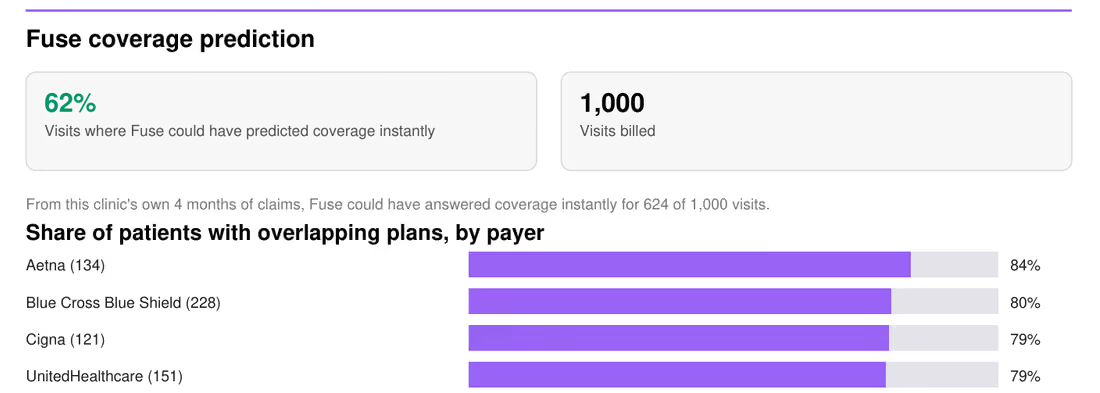

Fuse builds a model of payer behavior from your claims: underpayments flagged, lapsed plans caught, coverage predicted for scheduled patients.
Get Your Free Revenue AnalysisFAQs
What does Anthem pay for a 60-minute therapy session in Wisconsin?
Fuse's extraction of Anthem's September 2026 Wisconsin machine readable files shows the negotiated rate for CPT 90837, a 60-minute psychotherapy session, varies by plan and provider. The statewide mean was $206.03 and the median was $131.96 as of that extraction. Both pool many separate Anthem plan arrangements, so treat them as market reference points rather than a rate any one contract is guaranteed to pay.
Does Wisconsin require Anthem to pay the same rate for telehealth therapy?
No. Wisconsin has no law requiring commercial insurers to cover telehealth or to pay it at the in-person rate; a telehealth parity mandate has been proposed in three consecutive state budgets and removed each time. What Anthem pays for a virtual 90837 in Wisconsin is set entirely by the contract. Wisconsin Medicaid is the opposite: state law requires ForwardHealth to reimburse telehealth, and its policy pays distant-site providers the same rate as face-to-face care, including audio-only visits for functionally equivalent services.
Who is Anthem Blue Cross and Blue Shield in Wisconsin?
Two companies use the trade name: Blue Cross Blue Shield of Wisconsin, which underwrites PPO and indemnity policies, and its subsidiary Compcare Health Services Insurance Corporation, which underwrites HMO and point-of-service policies and issues all of the individual exchange plans. Wisconsin's Blue began in 1939 as Associated Hospital Services and operated for decades as Blue Cross and Blue Shield United of Wisconsin; it took its current corporate name in 2003 and joined the Anthem family through the WellPoint-Anthem merger in 2004. Both entities are Elevance Health subsidiaries and independent licensees of the Blue Cross Blue Shield Association.
What does Anthem reimburse for a psychiatric diagnostic evaluation in Wisconsin?
Fuse's extraction of Anthem's Wisconsin rate data shows a psychiatric diagnostic evaluation, billed as CPT 90791, carried a statewide mean of $221.11 and a median of $144.48 as of the September 2026 files. What a specific visit allows depends on the member's plan and the provider's contract, so use the statewide figures as reference points.
How does Wisconsin Medicaid pay for behavioral health compared with Anthem?
Wisconsin Medicaid prices outpatient mental health through an administered fee schedule with two rate tiers set by the clinician's credential: prescribers and doctoral-level clinicians bill the higher tier and masters-level clinicians the lower one, signaled by modifiers on the claim. Those maximums rose 15 percent effective January 2022 (some codes received a further 5 percent federal-relief increase) and have not been raised since. The current per-code maximums live in ForwardHealth's interactive fee schedule, and BadgerCare Plus HMOs negotiate their own rates that can differ from the fee-for-service schedule. None of it is negotiable the way Anthem's commercial contracts are, which is what makes the comparison useful.