BCBSTX TMS Reimbursement Rates in Texas (2026)
If you run or are weighing a TMS program in Texas, it’s crucial to understand what the state’s largest commercial insurer actually pays for the three codes the service line bills.
BCBSTX is a division of Health Care Service Corporation, a customer-owned mutual that runs the Blues plans of five states from one medical policy manual. The coverage rules below come from that manual, applied in Texas.
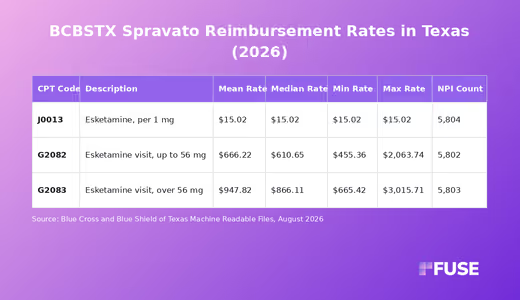
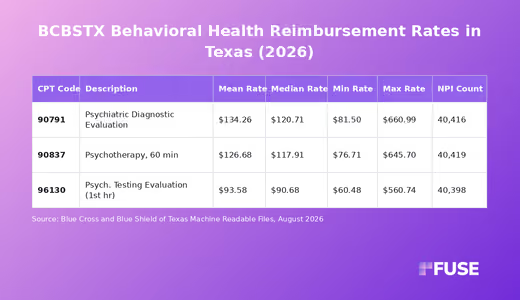
We analyzed BCBSTX’s August 2026 machine readable files, 38 gigabytes of pricing data unpacked, pooled across its Texas commercial network files, to produce the numbers below. We kept dollar-denominated negotiated rates billed as professional claims in the office setting, matched each NPI against the federal NPPES registry, kept individual psychiatric prescribers practicing in Texas, and computed statistics over distinct provider-rate pairs. Practices that also offer esketamine should see the companion analysis of BCBSTX’s Spravato rates in Texas, built on the same extraction, and the broader BCBSTX behavioral health rates page for the therapy codes.
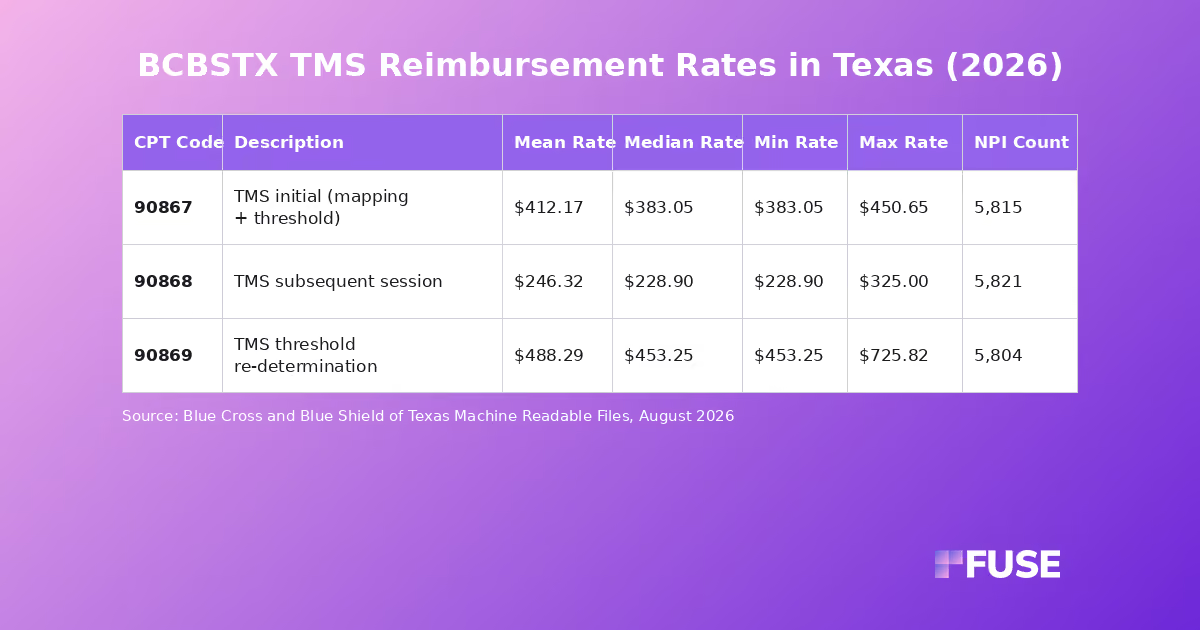
BCBSTX Negotiated TMS Rates in Texas
| CPT Code | Description | Mean Negotiated Rate | Median Negotiated Rate | Min | Max | Unique NPI Count |
|---|---|---|---|---|---|---|
| 90867 | TMS treatment, initial, including cortical mapping, motor threshold determination, delivery and management | $412.17 | $383.05 | $383.05 | $450.65 | 5,815 |
| 90868 | TMS treatment, subsequent delivery and management, per session | $246.32 | $228.90 | $228.90 | $325.00 | 5,821 |
| 90869 | TMS treatment, subsequent motor threshold re-determination with delivery and management | $488.29 | $453.25 | $453.25 | $725.82 | 5,804 |
Rates extracted from BCBSTX’s August 2026 Texas machine readable files.
What a Full TMS Course Pays in Texas
A typical TMS course is one initial mapping session (90867, once per course) and roughly 35 treatment sessions (90868), with motor threshold re-checks (90869) as clinically needed. At the August 2026 medians of $383.05 for mapping and $228.90 per treatment session, a completed acute course comes to $8,394.55 per patient. Treatment sessions are typically technician-delivered under supervision, so the revenue stacks on top of the clinician’s visit panel rather than replacing it.
A Houston TMS clinic publishes a sliding scale for a standard 36-session self-pay course. The top tier is $7,300, and BCBSTX’s median course of $8,394.55 pays more than that. Other listed cash prices are for different protocols: a Bellaire practice lists accelerated TMS at $4,600 and SAINT at $10,000. Compare your contract to the protocol you bill.
Prior Authorization at BCBSTX
TMS requires prior authorization on BCBSTX fully insured plans and certain self-funded groups. CPT 90867, 90868, and 90869 are on the 2026 commercial prior authorization code list, and BCBSTX reviews the request itself. The governing criteria live in HCSC medical policy PSY301.015, effective January 1, 2026.
The requirements are a confirmed severe major depressive episode documented with standardized rating scales, plus one of four gates: an inadequate response to two antidepressants from two different classes, each an adequate trial of at least six weeks with at least 80 percent adherence; inability to tolerate therapeutic doses; a documented response to TMS in a prior episode at least three months back; or candidacy for electroconvulsive therapy where ECT would not be clinically superior. On top of that, the policy requires a failed adequate trial of evidence-based psychotherapy. Standard, deep, and theta-burst devices are all within the medically necessary language. Maintenance TMS after remission is explicitly investigational.
Two dated policy shifts are worth knowing. Coverage extends to patients over 15, an adolescent expansion HCSC added in late 2024 that most commercial policies still lack. And as of January 1, 2026, TMS for obsessive-compulsive disorder moved to the investigational list after several years of conditional coverage, so OCD-primary referrals that would have cleared review last year will now be denied on the diagnosis alone.
The TDI Card Test: Which Rulebook Applies in Texas
Look at the front of the member’s ID card. Texas requires cards for state-regulated HMO, PPO, and EPO plans to show “TDI” (or “DOI”). BCBSTX uses that mark to identify fully insured members, and those are the members its fully insured prior-authorization list and Texas prompt-pay deadlines apply to. A card without TDI is non-regulated business. Many of those are self-funded employer plans, which generally follow federal rules instead of Texas insurance law, but the missing mark is not limited to those plans. Check the card, then confirm the plan.
Coverage beyond BCBSTX
Texas Medicaid does not appear to cover TMS. The codes are not in the state’s provider procedures manual, and managed care plan materials say it is not a covered service. Medicare does cover TMS for treatment-resistant depression, so the practical referral base is commercial members and Medicare beneficiaries.
Most of Texas’s 254 counties have no practicing psychiatrist. That is worth remembering when you negotiate a below-median rate.
What This Means for Your Program
The medians here are references from BCBSTX’s own published rates data. Make sure to check your own remittances for 90867 and 90868, and negotiate accordingly. If you are deciding whether to launch TMS, we suggest you build the business case on the median course figure above per completed patient.
Feel free to reach out if you think Fuse can help. We offer CPT-level verification of benefits before treatment starts, reimbursement checks against past claims, and analytics that flag the gap between contracted and paid before it compounds.
Disclaimer: This article uses rate information from the Machine Readable Files that Blue Cross and Blue Shield of Texas publishes under the federal Transparency in Coverage rule. These files are posted to satisfy the regulation, not to be read: the files behind this analysis unpack to 38 gigabytes of raw pricing data that no spreadsheet can open. Fuse built its own software to extract and verify the figures above. This analysis focuses on a single payer and will not reflect rates from all available insurance options in Texas. Fuse makes every effort to provide accurate and current information, but healthcare pricing and coverage policy change frequently, and individual circumstances affect actual payment. This information does not guarantee specific pricing. Practices should verify current rates and criteria directly with BCBSTX before relying on them for billing or negotiation decisions.

Fuse analyzes your claims data to estimate how many patients could be eligible, benchmarks your contracted rates against the market medians, and sizes the revenue uplift.
Get Your Free AnalysisFAQs
What is BCBSTX's reimbursement rate for TMS in Texas?
Based on BCBSTX's August 2026 Texas machine readable files, the median negotiated rate for a subsequent TMS session (CPT 90868) is $228.90, and the initial session with cortical mapping and motor threshold determination (CPT 90867) has a median of $383.05. Individual contracts vary widely, so treat these as statewide reference points rather than a quoted rate.
How much revenue does a full TMS course represent?
A standard acute course is one initial session (CPT 90867) followed by roughly 35 subsequent sessions (CPT 90868) over six weeks or more. At BCBSTX's Texas median rates that full course works out to about $8,394.55 per patient, before any motor threshold re-determinations (CPT 90869) that become medically necessary mid-course.
Which CPT codes are used to bill TMS?
Three codes cover therapeutic repetitive TMS: 90867 for the initial session (including cortical mapping and motor threshold determination, reported only once per course of treatment), 90868 for each subsequent delivery-and-management session, and 90869 for a subsequent session that requires re-determining the motor threshold. 90867 and 90869 are never reported together or with 90868 on the same date of service.
Does TMS require prior authorization?
Virtually all commercial plans, including BCBSTX, require prior authorization before starting TMS. Expect to document a qualifying major depressive disorder diagnosis, the antidepressant trials that failed at adequate dose and duration, and a standardized severity score such as the PHQ-9. Many plans also conduct a mid-course review before authorizing the full session count.
Does Texas Medicaid cover TMS?
Texas Medicaid does not appear to cover TMS. The codes are not in the state's provider procedures manual, and managed care plan materials say it is not a covered service. Medicare does cover TMS for treatment-resistant depression, so a Texas program's referral base is commercial members and Medicare beneficiaries.
Does BCBSTX cover TMS for teenagers in Texas?
Partially, and unusually: HCSC's TMS medical policy covers individuals over 15 years of age, an adolescent expansion added in late 2024 that most commercial policies still lack. The same criteria apply as for adults, including a confirmed severe major depressive episode documented with standardized rating scales and the policy's antidepressant and psychotherapy trial requirements.
Does BCBSTX cover TMS for OCD?
Not anymore. TMS for obsessive-compulsive disorder had conditional coverage under HCSC's policy for several years, but the January 1, 2026 revision moved OCD to the investigational list. OCD-primary authorization requests that would have cleared review in 2025 will now be denied on the diagnosis alone.